
Holiday times are upon us and it is time to hook up with all the friends and family that have been away all year or more. Or perhaps you are left alone by all your friends and family that left you to see their friends and family. In either case, there is a possibility of wondering what to do. Your trusty App, Google Maps, which you use to find and get to places has a new tab, For You.
Today, December 10th, the "For You" tab is appearing on Google
Maps in over 40 countries on iOS devices and whopping 130+ new countries on
Android devices.
You and your friends will certainly find up to date fun and information. Since the choices you will see are tailored to your tastes and preferences, you know exactly to meet your friends and or family.
The "For You" tab is designed
to be a constant source of inspiration tailored to you and will form to your neighborhoods or places you’re interested in
to get updates and recommendations. These include recent news about an
opening or pop up, a new menu item, and even restaurant suggestions
based on what you’re likely to enjoy. So follow the "For You" tab and double the fun.
Google Maps
Monday, December 10, 2018
Google Maps Mobile Brings "For You" Tab In Google Maps, To Over 40 Countries On iOS And over 130 Countries On Android.

Labels:
For You Tab,
Google maps

Google+ Bug Affected 52.5 Million Users Leading To Accelerated SunSetting. Google+ Will Shut Down In April 2019.

Google plan to shut down its social network effort, Google+ much sooner than planned after discovering a second bug that revealed millions of customers' private information via GOOGLE+ API.
Google admitted that 52.5 million Google+ users were affected by a bug in the November software update. The latest bug allowed app developers to access profile information not marked public. App developers inadvertently had access to this data for six days. Google is working on the system to curb any other issues.
In the light of all the missteps, Google will will shut down Google+ in April 2019
Our testing revealed that a Google+ API was not operating as intended. We fixed the bug promptly and began an investigation into the issue.
Our investigation into the impact of the bug is ongoing, but here is what we have learned so far:
We have begun the process of notifying consumer users and enterprise customers that were impacted by this bug. Our investigation is ongoing as to any potential impact to other Google+ APIs.
- We have confirmed that the bug impacted approximately 52.5 million users in connection with a Google+ API.
- With respect to this API, apps that requested permission to view profile information that a user had added to their Google+ profile—like their name, email address, occupation, age (full list here)—were granted permission to view profile information about that user even when set to not-public.
- In addition, apps with access to a user's Google+ profile data also had access to the profile data that had been shared with the consenting user by another Google+ user but that was not shared publicly.
- The bug did not give developers access to information such as financial data, national identification numbers, passwords, or similar data typically used for fraud or identity theft.
- No third party compromised our systems, and we have no evidence that the developers who inadvertently had this access for six days were aware of it or misused it in any way.
Google Security
Thursday, December 06, 2018
Today We See Jason Jones, A Recent Graduate Of The Last Mile, Beating The Odds.
Jason Jones, an incarcerated individual who selected the right path. Instead of being one of the incarcerated number, he decided to join, The Last Mile, a program for successful re-entry to the job market through business and technology training. This was at the San Quentin State Prison, where he was imprisoned for 13 years.
Appreciating the value of the program, Google.org announced today, a $2 million grant to The Last Mile. With this gift, the program will progress even further, across the United States. Also in the target is to establish its first program in an Indiana juvenile facility, Pendleton Juvenile Correctional Facility. There will be more Jason Jones.
Jason wrote a letter to future students of the program. Here is the letter in it's entirety, Thanks to Google Blog.
Dear students,My name is Jason Jones and I am a software engineer; however, that wasn’t always the case. For the majority of my life, I was whatever stereotype that public opinion thought would fit: at-risk, system impacted, low-income; the list goes on. I’m 35 years old and recently released from prison after 13 years.I come from a broken home, where gangs became family and the streets became my household. In 2014, while incarcerated at San Quentin State Prison, I entered The Last Mile program with no understanding of the opportunity it presented. It gave me a home and my new family. No one could have told me that this one decision would turn my life around.Before The Last Mile, I had no idea what coding was or how technology worked. I had no real plans of rehabilitation or changing my mind set. Through coding, I was able to redefine how people perceived me. I became part of another underrepresented group: a person of color in tech with a non-traditional background.Through the program, I found classmates, instructors and volunteers who were genuinely invested in my education and in me as a person. We spent thirty-two hours each week learning skills like JavaScript, web development, team collaboration and how to navigate the workplace. I discovered mentors and positive role models who I could go to with problems or for advice.Since graduating from the Last Mile, I signed a contract with a tech company that was interested in my success, and I relocated to a better place for growth and prosperity. And just two months out of prison, I’m able to travel on a plane for the first time in my life, visit parts of the country I’ve never been, and do things that I thought were out of my reach.This process has been anything but easy. It takes a lot of hard work, commitment, discipline, focus and sacrifice.I’ve faced a lot of adversity in my life, but coding gave me a different approach to solving problems. It taught me how to break down the larger problems into smaller, workable ones and create a workflow that leads to a solution. I’ve learned better communication skills and how to collaborate successfully on a team. I’ve learned how to break down some barriers that were stunting my growth and learned how to ask for and accept help. But most of all, I’ve learned how to take control of my life and set the direction in which it is going.All of you have the opportunity to reimagine what you want your life to look like—always be your best self and believe in the process. This keeps me on a positive path.Yours truly,
Jason Jones
Wednesday, December 05, 2018
Morse Code Found A way to Reach in To People's Hearts, Thanks to Google's AI powered Gboard.
Developer Tania Finlayson
has found her voice, being she is voice less through Morse code. It is one of her shining abilities among many others. Now she’s partnering with Google to
bring Morse code to Gboard, so others can try it for accessible
communication and many others have already done it, very successfully.
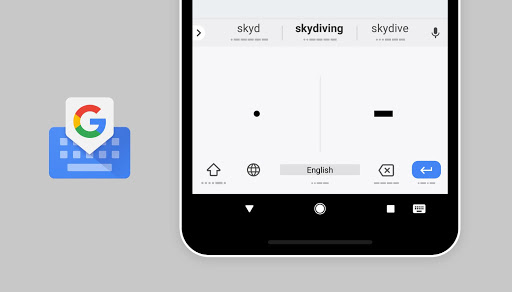
"We created this trainer to make the process of learning Morse code more fun and to encourage people to keep at it. Give it a try if you’ve set up Morse code for Gboard and are ready to learn Morse.
This experiment is part of a larger project to support Morse code for accessible communication. Learn more about it at g.co/morse."; invites Experiment with Google.
Google's Morse code for Gboard includes settings that allow users to customize the keyboard to their unique usage needs. It works in tandem with Android Accessibility features like Switch Access and Point Scan.
Morse code on Gboard for iOS and improved Morse code on Gboard for Android are available from respective App Stores..
This provides access to Gboard's AI driven predictions and suggestions, as well as an entry point to AI-powered products, like the Google Assistant.
Labels:
Accessibility,
AI,
Gboard,
Morse Code
AI for Social Good, Google's Collective AI Initiative For Our World Through Google AI Impact Challenge
Google has been working on AI, Artificial Intelligence both internally and with external partners. While AI is wide field what is in focus here is the AI for Social Goodness.
Google mentioned in post;
As a part of AI for Social Good, Google is launching the Google AI Impact Challenge. It is an invitation for nonprofits, academics, and social enterprises from around the world to submit proposals on how they could use AI to help address some of the world’s greatest social, humanitarian and environmental problems. Google will assist chosen organizations to make their proposals successful with coaching from Google’s AI experts, along with Google.org's grant funding from a $25 million pool, and credits and consulting from Google Cloud. Further the Grantees will be a part of a specialized Launchpad Accelerator program, with data science nonprofit DataKind.For the past few years we’ve been applying core Google AI research and engineering to projects with positive societal impact, including forecasting floods, protecting whales, and predicting famine. Today we’re unifying these efforts in a new program called AI for Social Good. We’re applying AI to a wide range of problems, partnering with external organizations to work toward solutions.
Apply and present your proposals, as in spring of 2019, an international panel of experts, who work in computer science and the social sector, will help Google to choose the top proposals.
To give you a sense of the potential we see, here are a few examples of how Google and others have already used AI over the past few years:
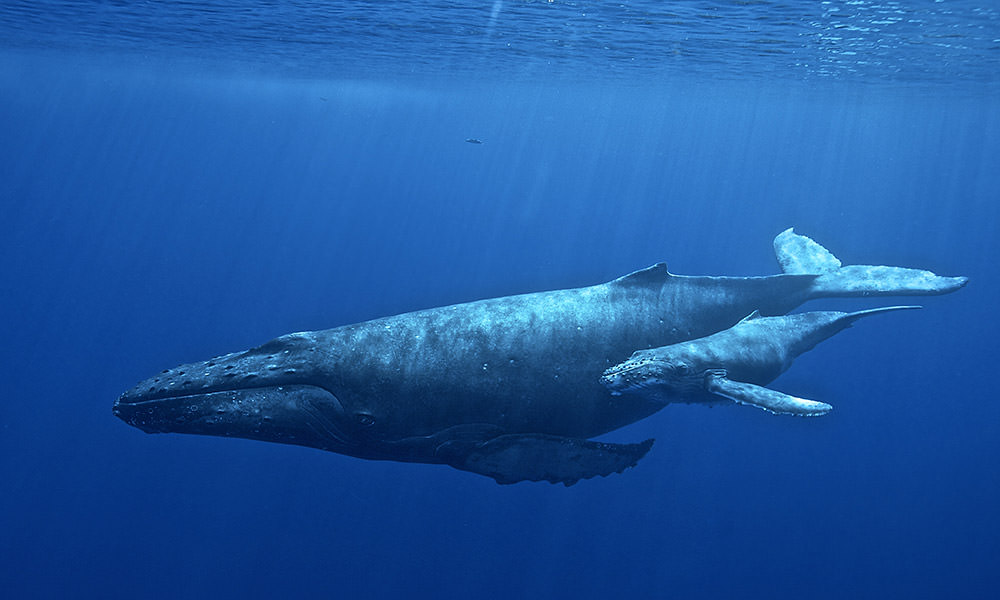
- Wildlife conservation: To better protect endangered whales, we have to know where they are. With AI developed at Google—in the same vein as research by college student Daniel de Leon—it’s possible to quickly scan 100,000 hours of audio recorded in the Pacific to identify whale sounds. We hope one day we can not only better identify whales in these recordings, but also accurately deploy this system at scale to find and protect whales.
- Employment: In South Africa, Harambee Youth Employment Accelerator helps connect unemployed youth with entry-level positions. As a participant in Google Cloud’s Data Solutions for Change program, they’ve used data analytics and ML to match over 50,000 candidates with jobs.
- Flood prediction: Floods affect up to 250 million people, causing thousands of fatalities and inflicting billions of dollars of economic damage every year. At Google, we’ve combined physics-based modeling and AI to provide earlier and more accurate flood warnings through Google Public Alerts.
- Wildfire prevention: Two high school students in California built a device that uses AI to identify and predict areas in a forest that are susceptible to wildfires. This technology could one day provide an early warning to fire authorities.
- Infant health: Ubenwa is a Canadian company that built an AI system to analyze the sounds of a baby crying and predict the risk of birth asphyxia (when a baby's brain and other organs don’t get enough oxygen and nutrients during birth). It’s a mobile app so it can be widely used even where doctors aren’t readily available.
Labels:
AI,
AI for Social Good.,
Artificial Intelligence,
google


